APEX Weekly Signal Report (June 6, 2026)
- 3 days ago
- 4 min read
Current Allocation: 100% BIL (cash proxy). TQQQ position: 0%.
The APEX QQQ Trading Algo remains entirely in BIL. The risk-on gate is fully open and the machine learning model is in sole control of the allocation decision.
What Happened Last Week
It was an eventful one. Eight weeks into a semiconductor-led rally, Broadcom hit the skids. The firm's forward guidance came in below Wall Street expectations, and the market was unforgiving — the stock sold off 16% the morning after the print and extended those losses to roughly 20% by Friday's close. The higher they fly, the harder they fall.
The Philadelphia Semiconductor Index took the blow squarely, tumbling 12% over two days. Whether this is sector rotation — as some on the Street are arguing — or the leading edge of a more sustained downturn remains to be seen. What is worth noting is that a handful of names within the index are carrying particularly stretched valuations. Based on a blended set of eight key valuation metrics, ALAB, MPWR, CRDO, MTSI, and COHR stand out as the most elevated in the index. If the selling pressure extends or intensifies, these are the most vulnerable names.
The other major market-moving event was Friday's jobs report. The print was stronger than expected, which would normally be welcome news — but in the current environment, strong labor data complicates the Fed's calculus. Any lingering hopes for a 2025 rate cut evaporated on the spot. The market is now pricing in something considerably more sobering: a rate hike. Per the CME's FedWatch tool, there is a 72% probability of one by year-end. Inflation is back in the driver's seat for now.
All told, QQQ shed 5.5% on the week, the bulk of it arriving Friday afternoon. This is a meaningful move, but not an entirely surprising one. The index had been running hot for eight straight weeks, momentum had been visibly decelerating over the prior three, and last week's brief dip to the lower 1.5-sigma band — the first close anywhere near that level since the rally began in late March — was, in hindsight, a quiet warning shot. Still, QQQ remains well above its 200-day moving average. The structural trend is intact.
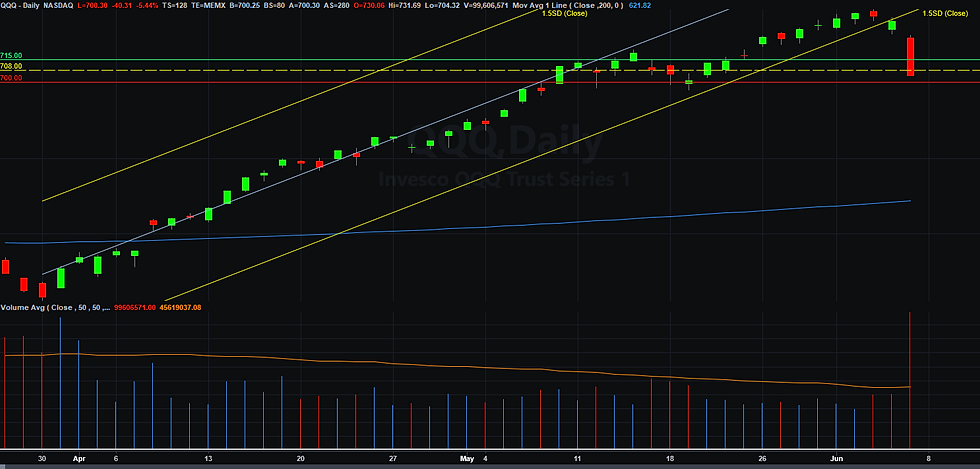
What Does History Say Happens After a Drop Like This?
Futures are trading up nearly three-quarters of a percent as I write this, suggesting the bulls may attempt to reclaim some ground Monday morning. But it is worth stepping back and asking what the historical record says about drops of this magnitude — and whether the context of a prior runup changes the picture.
Looking at all 48 instances since 2006 where QQQ fell 4% or more in a single trading day, the forward return picture is constructive but noisy. The median outcome at one month is only a modest +1.6%, with barely over half of instances finishing higher. At three months, however, the picture improves considerably — a median gain of +12.4%, with 83% of non-crisis instances ending in positive territory.
When the filter is tightened to only those instances where the drop occurred within a genuine bull market rally — specifically, where QQQ was well above its 200-day MA and had posted a strong positive trend over the prior two months — only four historical data points emerge, all from 2020. This sample is too small, too concentrated, and too contextually different to be meaningful. The more honest takeaway is that sharp drops inside bull market rallies have historically resolved to the upside over a quarter — but they often grind lower before doing so. In a piece over at Seeking Alpha, Lance Roberts draws a similar conclusion noting that '5% - 8% pullbacks are not the sort of things that shake trend following conviction; they embolden it.'
The APEX Signal
The June 6 run produced a composite probability of 0.466 — up from 0.350 the prior week, a meaningful improvement. Counterintuitively, Friday's -4.8% drop was actually constructive for the near-term ML signal: the compression in QQQ's stretched position above its 200-day moving average, and a modest cooling in the smoothed momentum indicators, both read as slightly more favorable near-term conditions to the model. The 3-month probability rose 24.1% to 37.8%, while the 6-month probability held steady at 96.8%.
That said, 0.466 is still well short of the threshold required to trigger a TQQQ entry. We have moved up, but there is no real conviction in the near-term signal — it is little more than a coin flip on the 3-month horizon. The gate remains open and the structural setup is intact, but the model does not yet have enough conviction to justify exposure to a 3x leveraged instrument. The next retrain is approximately three weeks out, at which point the model will formally reassess with the full impact of last week's data incorporated into its training window.
On Deck This Week
There is plenty on the calendar to keep things interesting. CPI drops Wednesday and PPI follows Thursday — both the headline and the constituent readings will be closely watched. The Fed is already leaning hawkish, and hot numbers on either report could accelerate the rate hike narrative. On the other hand, a more friendly report could give Mr. Market the excuse he needs to resume his upward move.
On the earnings front, Oracle reports this week and will be scrutinized for any further cracks in enterprise CapEx spending — particularly cloud and AI infrastructure. Adobe follows, where the Street will be looking for evidence that AI monetization is starting to show up in the numbers in a meaningful way rather than just the narrative. Either or both could move the tape.
All in all, it has the makings of another eventful week. With APEX sitting on the fence and the macro backdrop still carrying significant headline risk (and all of this is not to mention the Iran War), I believe caution remains the better part of valor. Hence, I am out and in cash again this week, at least with the possible exception of a short on the aforementioned high-flying semiconductor stocks.

